







































































Choosing what filament, the little spool of plastic that extrudes to make something, can often be extremely overwhelming. In this guide, I will present the most common types of filament, their acronyms, and why they might be chosen over other types. Have fun!
How to Identify Filaments
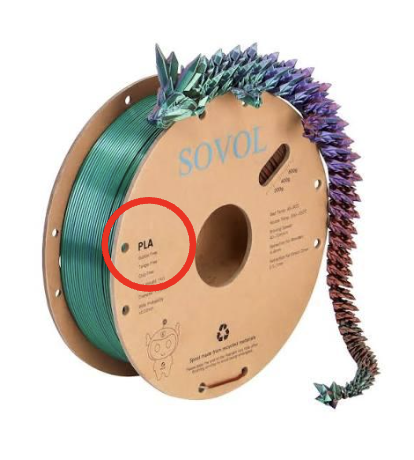
Before I get to listing the types of filaments, let me first explain how to identify the filament type from a random spool of filament. Look at this example filament wheel. Circled in red is the filament type, which is how you identify the type of filament on each spool.
Filament Types
The most common types of filament are PLA, ABS, TPU (A Flexible filament), and PETG. I will now go into each type of filament and explain its uses.
PLA
PLA stands for Polylactic Acid, and it is by far the most commonly used plastic for 3D printing. Despite having acid in its name, it’s non-toxic. Additionally, PLA melts at a lower temperature than a lot of other options, and it’s made of corn, making it less harmful to manufacture. PLA is also safe to print without good ventilation, is one of the only types of filament that can be printed on a non-heated surface, and is fairly cheap. However, using PLA has a few disadvantages; PLA has very low tensile and impact strength, which basically just means that it breaks easily. Additionally, due to PLA’s low melting point, if left in the sun, it is likely to deform, so it can’t be used in high heat or outside at all. I would recommend using PLA for quick, aesthetically pleasing prints or for prototyping more complex parts. PLA can be used in food containers; however, it will melt in the dishwasher, and there can be problems with its sanitation, so I wouldn’t recommend it.
Click here to learn more about PLA!
ABS
If someone isn’t printing in PLA, then they’re probably printing in ABS. ABS stands for Acrylonitrile Butadiene Styrene. One of its key features is its durability, so it’s best used in things that need to last. Also, ABS is extremely heat-resistant, so it can last without a problem. However, ABS doesn’t melt easily, so it can be hard to print due to inconsistent or too low temperatures. Additionally, ABS is non-biodegradable, and it releases mildly toxic fumes during printing. ABS must be printed in a well-ventilated area (also, it doesn’t smell very good). It’s non-toxic if swallowed, but it also won’t break down in the stomach, so don’t eat it, please. Despite the aforementioned downsides, ABS is undeniably one of the most useful and widespread filaments in 3d printing. It’s used in luggage, helmets, camera mounts, children’s toys, LEGO, and kitchen appliances. I would recommend using it for final prints that need to last a long time.
Check out more about ABS here!
PETG
If you were disappointed that ABS isn’t suitable for food containers, then look no further than PETG, Polyethylene terephthalate glycol. PETG is a fan favorite of the water bottle industry because it’s extremely chemically resistant, and food can be placed without chemical leakage. Moreover, the surface of an object made out of PETG can be smoothed using heat to prevent bacteria from growing in the cracks. It’s also completely recyclable, so it’s better for the environment than a lot of other plastics. It’s one of the easiest plastics to print with, great bed adhesion, and if you’ve ever tossed a water bottle, you’ll know it has extremely high impact resistance. Rather than breaking, this plastic can flex and bend to withstand an immense amount of pressure. However, using PETG has some drawbacks. PETG’s stickiness means it has great bed adhesion, but at the same time, it also means it has a tendency to ooze and leave wisps of filament trailing around your print. PETG is also nearly impossible to print as its high chemical resistance means that paint slides off. Overall, when using the right settings, PETG can be a fantastic option for food-safe prints, but I wouldn’t use it for anything that needs to be stiff.